The International Business Times: “More Efficient Hydrogen Fuel Cells Developed by Researchers”

The International Business Times, one of the world’s leading business news organizations, has published an article entitled “More Efficient Hydrogen Fuel Cells Developed by Researchers” about our new approach to rational design of cost-effective catalysts for hydrogen fuel cells published in Journal of Physical Chemistry Letters ( J. Phys. Chem. Letts. 3, 463 (2012)) http://au.ibtimes.com/articles/318299/20120323/more-efficient-hydrogen-fuel-cells-developed-researchers.htm#.Ue-Rj403uSo

“The Engineer”: Researchers seek to improve efficiency of hydrogen fuel cells

An article “Researchers seek to improve efficiency of hydrogen fuel cells” featuring Prof. Stolbov and my work has been published in “The Engineer” the only magazine serving the United Kingdom’s engineering technology community since 1856. Reference:  http://www.theengineer.co.uk/energy-and-environment/news/researchers-seek-to-improve-efficiency-of-hydrogen-fuel-cells/1012018.article  

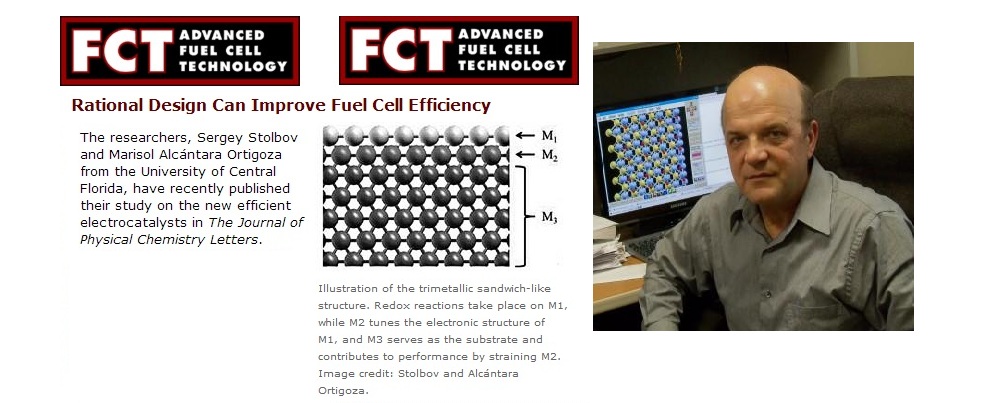
The Advanced Fuel Cell Technology: Rational Design Can Improve Fuel Cell Efficiency

The Advanced Fuel Cell Technology magazine, published by Seven Mountains Scientific, Inc., has devoted to our work an article entitled “Rational Design Can Improve Fuel Cell Efficiency” highlighting that our rationally designed materials may improve both efficiency and cost-effectiveness of fuel-cells cathode catalysts, outperforming the best platinum-based catalysts to date. Reference: http://7ms.com/fct/online/2012/03/rational-design-can-improve-fuel-cell-efficiency.html  

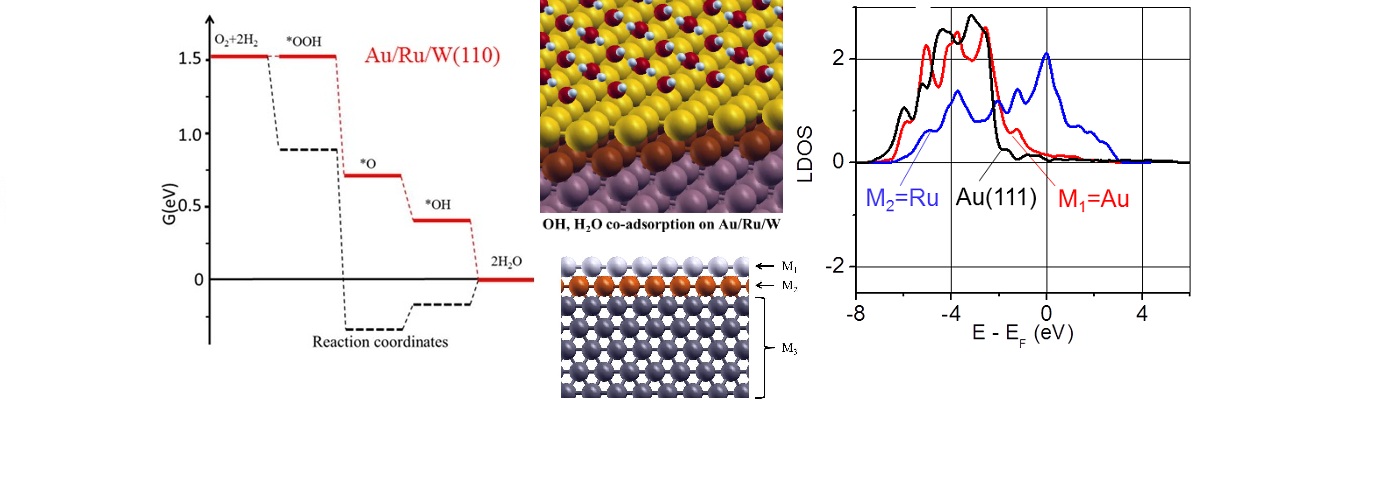
Rational Design of Competitive Electrocatalysts for Hydrogen Fuel Cells

[J. Phys. Chem. Letts. 3, 463 (2012)] The hydrogen fuel cells convert chemical energy stored by hydrogen molecules into electric energy and the only product of this reaction is clean water. However, large-scale practical applications of these very promising sources of clean renewable energy are still restricted by unacceptably high cost of platinum-based catalysts that are […]

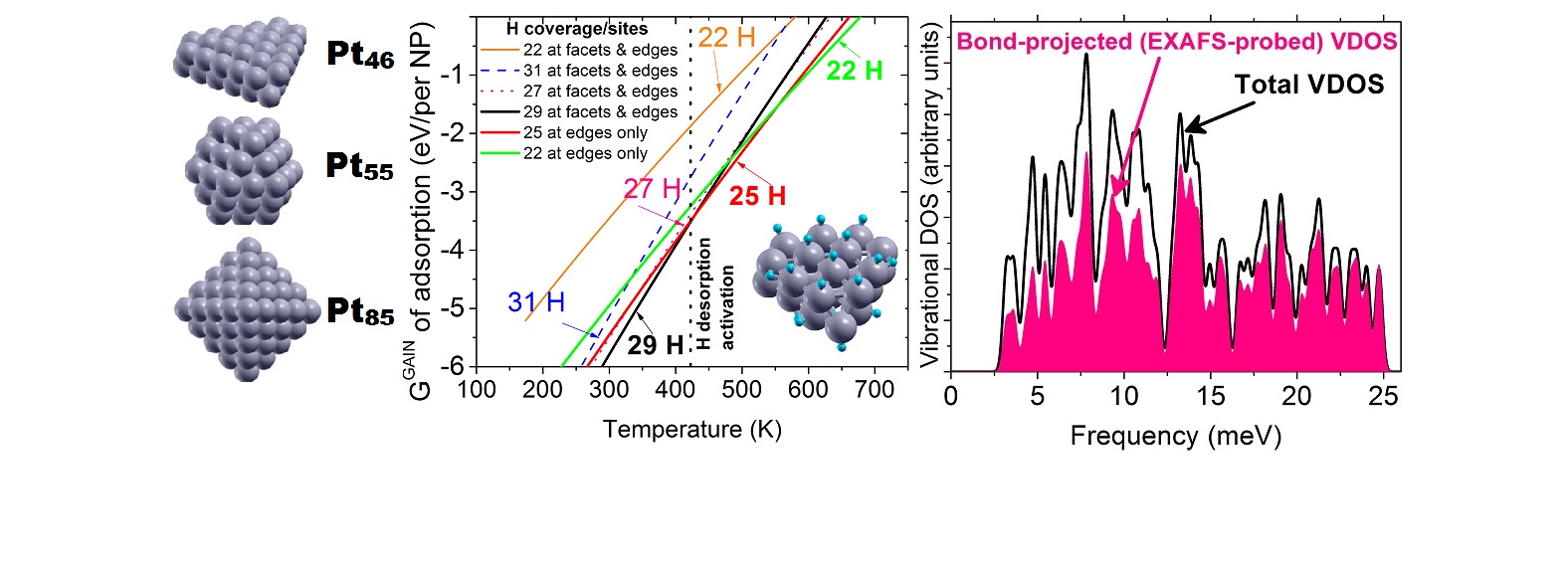
Explaining the negative thermal expansion of Pt nanoparticles and their unexpectedly low “mean-squared amplitude” T-dependence (EXAFS selectivity)

[Phys. Rev. B 84, 245438 (2011)] As experimentalist design better and better techniques to investigate nanoscale systems, anomalous electronic and thermodynamic properties for nanoparticles (NPs) continue being reported. Yet, despite several years of investigations, the origin of these effects was, until recently, still heavily debated. Among the inexplicable “anomalies”, I have focused on understanding those reported […]